Although I have a little page where I keep track of the books I've read, I also have an account on StoryGraph. I find it handy to track which books I've read, but I don't really use it to find new books, connect with others, or write reviews.
One of the site's features presents a set of statistics about the books you've read and tracked using the website. It plots out the moods, genres, medium (i.e. paper, e-book, audio book, etc.), it also indicates the average time you have taken to complete a book and plots out the number of books/pages that you have completed for each month.
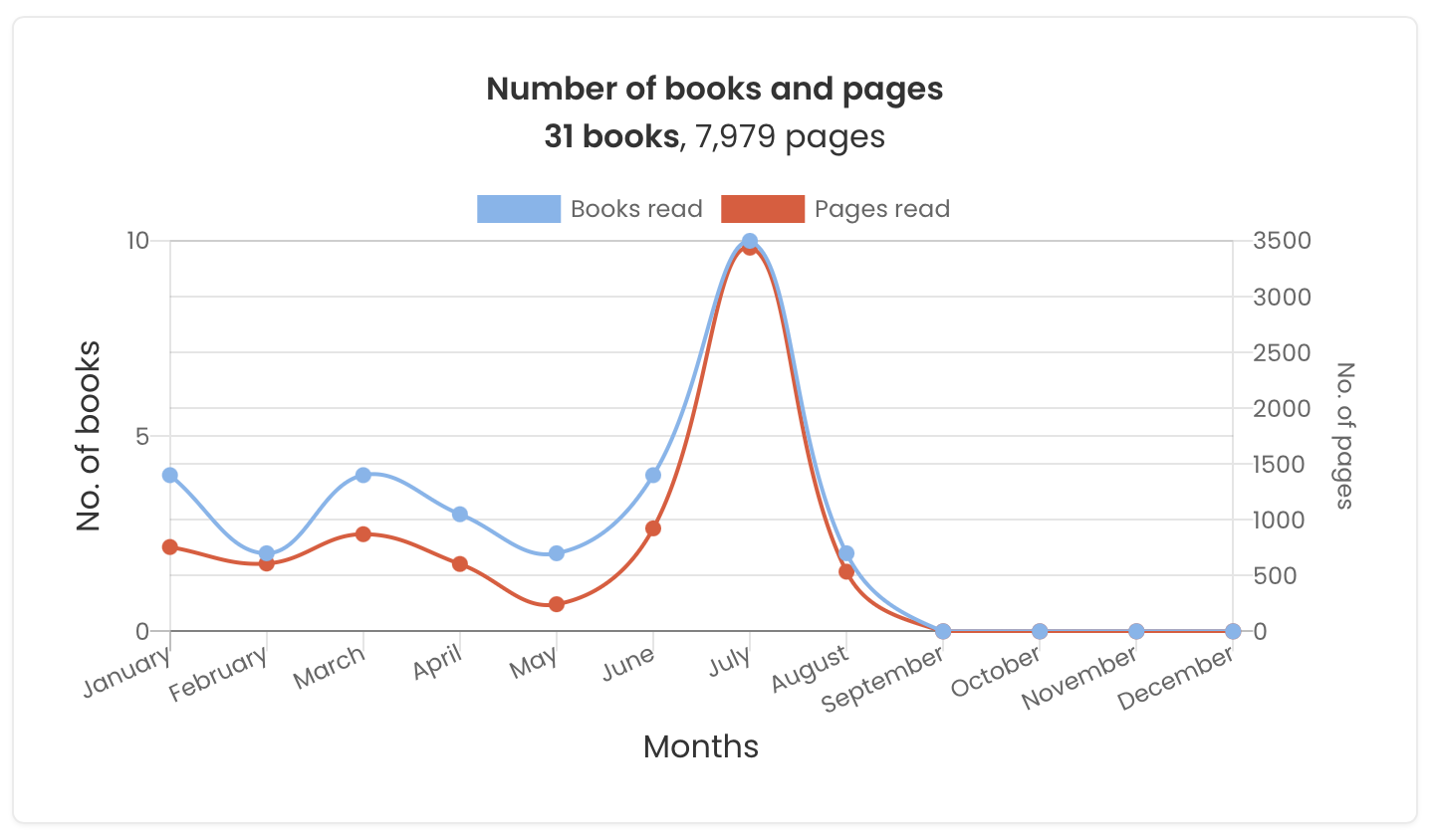
These statistics are somewhat interesting, though I don't need software to tell me that I seek out queer books packed with emotion or that I only read printed books. I suppose the statistical dashboard is more for others, or at least facilitating interaction with them.
It's interesting though. It seems to crop up more frequently during the "end of year" wrap-up season, but many people seem to get really competitive about the number of books they've read.
Or I suppose, "read" is more accurate.
One doesn't have to spend too much time on the internet to trip over a nest of Book-stagrammers, -tokkers, or -tubers one-upping one another for the number of books they've consumed over they year, what they're on track to achieve, and how they've accomplished such feats of superhuman literacy.
That's where you learn that it's less about dedicating themselves to great stories, feeling-the-feels, or learning something new about the human condition, and more about dedicating themselves to the little internet trophy: skipping entire portions of the book, focusing on audio books listened to at 1.5x, 2.5x, or even 4x, and even choosing books that are written in a certain way that are easier to digest (i.e. those that are dialogue heavy, written for young adults, or skipping expository or descriptive text, etc.).
I suppose they're deriving pleasure from competition, because it doesn't sound like they're deriving pleasure from the actual content of the books.
A Tradition of Performance
It all reminds me of two different things that share the same performance-oriented root: academics and the weird 1980s "thing" with speed readers.
When I was in grad school, I encountered both faculty and would-be faculty (PhD students studying for their comps) who took great pride in letting undergrads and Masters' students in on a little secret: the reading list might look long, but it's only long if you've not yet learned how to skim and summarize. Some took it further and claimed only to read the introduction and perhaps conclusion.
The idea being, of course, that you only need to know what a particular scholar has argued, less whether or not their argument actually stands on a foundation of evidence. You don't need to worry about that: you've planned to apply some form of existing theory to your argument. A long-deceased pederast has done the thinky work for you.
The real ones know that it's better to engage widely than it is to engage deeply. A long list of works you've only skimmed in your bibliography means you've successfully performed the core work of the intellectual.
I realize that this comes off as a little cynical, but the further I get away from being in a university fold, the more that sort of performative and cynical way to engage with the work stands out.
Of course, it's not limited to academics: we all work with people who engage with their tasks strategically to maximize benefit while minimizing effort. Since the principal role of the university is the manufacture of prestige (they'd operate somewhat differently if their purpose was the pursuit of knowledge and truth), it makes sense.
It's an all-too-common way to burn out us Lisa Simpson types.
It also reminds me of speed reading, which I remember being something of a trend in the 1980s, complete with variety shows and news broadcasts where they'd have someone stand on stage, run their fingers quickly over the text in a book (often while mumbling said text) and then turn around and tell the host what the book was about. I remember it sometimes being serious, but often presented using the same production style as when they'd get a dolphin to use a cash register.
The idea was that the faster you could read (or summarize, get the gist of) something, the smarter you are.
Getting to the Point
Seeing my little line graph and its reflection of the considerable amount of reading I have done in recovery from surgery, a little voice of encouragement has sort of begun to show up in my mind that I have to keep going. And indeed, as I've been healing enough to get outside more and do other things that aren't bed rot, I've come to feel just a twinge of guilt as my reading has also slowed down a little.
This gremlin has long been with me: intelligence and academic achievement being among the the things I could do to establish my value as a person.
On the upside (?), another digital metric prone to creating meaningless and joyless competition — the step counter on my iPhone — has been seeing a mirrored increase in numbers, almost as if there is a mathematical relationship between steps and pages.
One page = one step not taken;
One step = one page not read.
It turns out that I'm not a woman who can have it all...
August 6, 2026